

The government has approved Rs. 95 billion in concessionary interest loans for 2026, marking the highest allocation of its kind in Sri Lanka’s history, according to Deputy Minister of Industry and Entrepreneurship Development Chathuranga Abeysinghe.
In a statement, the Deputy Minister revealed that Rs. 25 billion of the total allocation had been earmarked to support the expansion of small and medium-scale enterprises (SMEs), covering businesses with an annual turnover of up to Rs. 1 billion.
He stated that the scheme caters to a wide range of businesses, from micro-enterprises with an annual turnover below Rs. 20 million to medium-scale enterprises with a turnover of up to Rs. 1 billion.
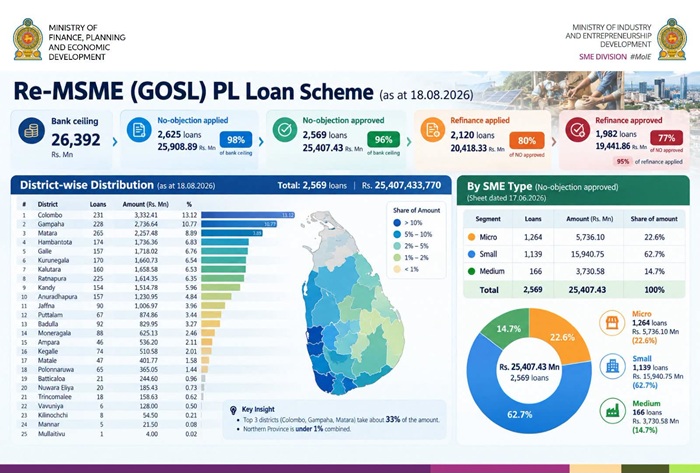
According to Abeysinghe, 2,569 beneficiaries had qualified for concessionary loans by August 2026, describing the progress as a significant achievement for the programme.
Providing a breakdown of the loan distribution, the Deputy Minister said small enterprises had received Rs. 16 billion from the Rs. 25 billion allocation, including Rs. 5.7 billion obtained by micro-enterprises.
Meanwhile, medium-scale businesses with an annual turnover exceeding Rs. 350 million but below Rs. 1 billion had received Rs. 3.7 billion, distributed among 169 enterprises.
Addressing concerns that concessionary loans were being directed mainly towards larger businesses or disproportionately allocated to certain provinces, Abeysinghe said the programme is reviewed monthly by himself, the Secretary to the Ministry of Finance and the Ministry’s Department of Development Finance.
He noted that the regional distribution of loans broadly reflected the country’s GDP distribution, adding that greater regional balance could be achieved by developing stronger businesses across different parts of the country.
The Deputy Minister further highlighted that the 2,569 beneficiaries who obtained concessionary loans would not be eligible to receive further concessionary financing under the scheme for the next three years, creating opportunities for new applicants.
He urged aspiring borrowers to establish formal, financially stable businesses and maintain trustworthy relationships with banks, stressing that entrepreneurs must take responsibility for their financial records and Credit Information Bureau (CRIB) scores.
Abeysinghe also advised business owners to pay greater attention to their equity capital and maintain monthly records of income, expenditure, assets and liabilities to improve their eligibility for bank financing.
He added that entrepreneurs could obtain the necessary technical assistance from the Ministry of Industries to prepare their businesses for loan applications. (Newswire)